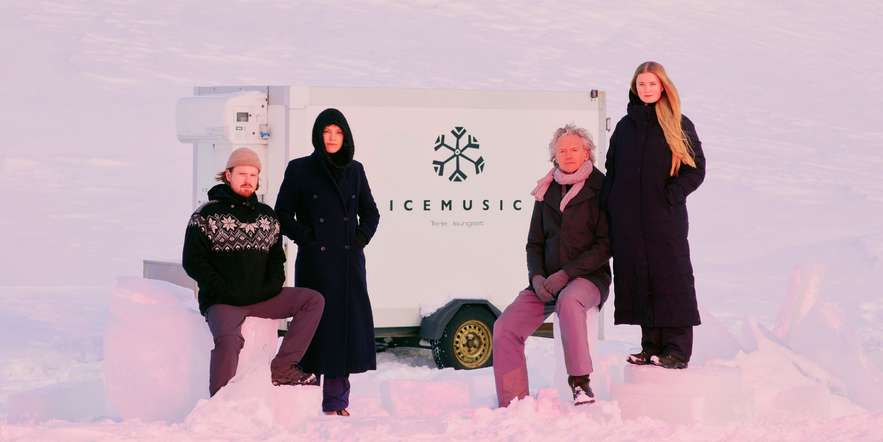
Ahead of our tour later this month with the Terje Isungset Ice Quartet, we caught up with Terje to learn more about the process of making, storing and playing these amazing ice instruments.
Where does the ice come from?
Natural frozen ice is harvested from the lakes in Norway. Terje Isungset says, “the sort of artificial, machine-made ice is useless. It is acoustically dead. That’s a logistical problem for me, but also rather nice – the notion that only ice directly from nature has musical potential.”
Each winter, ‘harvesting time’ as he calls it, Terje Isungset and his team hew the ice out of the lakes. “First you use a manual ice drill. Then you push your saw blade in and start sawing by hand. The trickiest part is to pull the ice blocks out without falling in the water.”
_large.jpg "Ice Music Harvesting")
Ice instrument harvesting - Photo by Andreas Gasser.
Does the ice sound different depending on where it is harvested?
It does. Terje Isungset says that the ice sounds different depending on when and where he harvests it. He says “I have some secret places, lakes where there is normally good-sounding ice – but you can never be sure. It’s like wine. You have good years and bad years.”
And the sound of ice reflects human activity too. Terje says: “I have known ice harvested from the same lake at the same time to vary widely in sound. That was in Russia, and I think it related to pollution levels.”
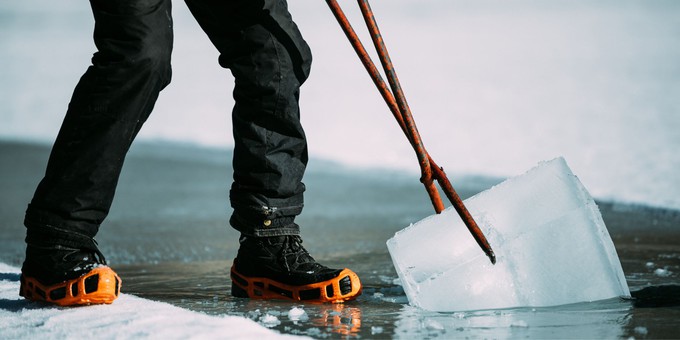
Ice instrument harvesting - photo by Andreas Gasser.
How are the instruments created?
The instruments are made from the natural frozen ice harvested from the lakes in Norway and are carved by Terje and his team of skilled professional ice carvers using saws, drills and chisels.
_large.jpg "Ice instrument carving")
Ice instrument carving - photo by Andreas Gasser.
How are the instruments transported and kept frozen during the tour?
The quartet have a special ice trailer which transports all the ice instruments and keeps them frozen at below -20ºc while on tour. They will be using their ice trailer for the UK tour.
However, they use local ice where possible, particularly when travelling to very far and to very cold places. For example, when they travelled to China, Japan, Russia, Canada, USA, Australia(!), Greenland, the Alps in Europe and Finland. They enjoy collaborating with the locals to create a magic ice happening, harvesting ice from various lakes to find the best sound, then creating the instruments and performing a concert. Sometimes they also build the venue out of snow and ice – normally an amphitheatre or an igloo. Terje says, “after the concert, we give everything back to nature – the venue and the instruments – as these are not mine. I simply have borrowed them from nature.”
_large.jpg "Ice Music Trailer")
Ice Music Trailer - photo by Emile Holba.
How are the instruments kept frozen on stage?
They are not. Whilst onstage in an indoor concert hall (or any concert venue above 0ºc), the instruments are slowly melting.
This is mitigated by strategically placed dry ice around the instruments, but this is why the concert cannot last over 90 minutes and is performed without an interval. Lighting is also a consideration. Ideally, venues use LED lights that produce less heat than traditional lighting and lighting is strategically placed to not direct unnecessary heat onto the instruments.
The audience are all seated in the concert hall before the instruments are moved onto the stage – to reduce the amount of time that the ice instruments are onstage.
Terje says, “The temperature in the concert hall is normal. Around 22 degrees. As far as we know there are no other musicians or bands in the world that can play a full scale indoor ice concert.”
_large.jpg "Ice Music - photo by Laurence Harvey")
Terje Isungset performing ice percussion live on stage - photo by Laurence Harvey.
Do the instruments sound different between the beginning and end of the tour?
Yes. While outside of the refrigerated trailer, the instruments slowly melt onstage. This means that the instruments are slightly smaller by the end of the tour. This also affects the sound and tuning of the instruments, which means the musicians are constantly needing to fine tune their instruments. Each concert hall is different and the ice sounds and reacts differently depending on the environmental conditions of the space and the size of the audience within it.
Does the cold of the ice affect the tuning of the stringed instruments (like the ice bass and ice harp)? How are they kept in tune?
The combination of strings, the cold, the warm, the humidity, the melting ice and staying in tune is only to be done by very skilled musicians. It is very challenging for sure!
Terje says, “I tune the ice instruments before every concert to be exactly in tune. The stringed instruments have to be adjusted before and during the concerts.”
_large.jpg "Ice Music - harp and percussion")
Ice Music instruments - ice harp and ice percussion - photo by Laurence Harvey.
What's the next ice instrument you would like to create?
Terje says, “one instrument for peace! And one instrument for taking care of nature! At my Ice Music Festival we always have ‘the instrument of the year’. This has been ongoing for 21 years now. We have made some of the most amazing ice instruments, like the TubaIce and the IglooSax. Can you imagine the sound and what they look like?”
What's the most unusual ice instrument you've created?
Terje says, “we had the amazing trumpet player Arve Henriksen to play an ice trumpet in to the lake (we made a hole in the ice) - then from the other side of the lake we made another hole and picked up the sound via a hydrophone mic - and then sent the sound to the stage. So the audience could listen to the same music as the fishes in the lake! And we performed together with this sound, along with my band on stage.”
_large.jpg "Ice instrument carving")
Ice instrument carving - photo by Andreas Gasser.
Why ice?
In 1999, Terje was commissioned to write music for a concert under a frozen waterfall at Lillehammer, Norway. He decided to use elements from the river itself as musical instruments in his composition; stones, wood and finally – ice. Terje explains, “I took the sound from underneath the waterfall, and then I hit the ice. I thought it was so beautiful. It was like falling in love.” Discovering the sounds of natural ice opened up a whole new range of sonic possibilities for Terje, his ice journey had begun.